Free PDF — 5 Movements a Week:
What I Actually Do for My Spine
Five movements I return to most weeks with 44-degree scoliosis, multilevel degenerative disc disease, and severe foraminal stenosis on file. Personal record. No program. No prescription.
Send me the PDF →
Stay on the record. Get updates when new documentation is published. Add my name to the email.
Spine
Imaging-confirmed findings. No back surgery. Age 60.
By Jonas Virgil Monos | Exception Nation LLC
Published: June 20, 2026 | Last updated: June 20, 2026
This page documents what the imaging shows. It does not interpret why my body continues to perform under these findings. It does not offer that performance as evidence of what any other body can or should do. It is a record. The imaging is mine. The output is mine. The gap between those two facts is in the record. What any reader does with that gap is between them and their physician.
Editorial note: All imaging studies referenced on this page are from University Health, San Antonio, TX — a verified academic medical center. Radiologist names are partially redacted to last initial for privacy. Study types, dates, and findings are reproduced accurately from the imaging record. This page documents personal medical history only. It is not medical advice.
Imaging on Record
Five studies are on file at University Health, 4502 Medical Drive, San Antonio, TX 78229 (UT Health San Antonio affiliated), conducted between 2020 and 2024. Additional studies conducted at outside facilities are on file. Findings are consistent with this record.
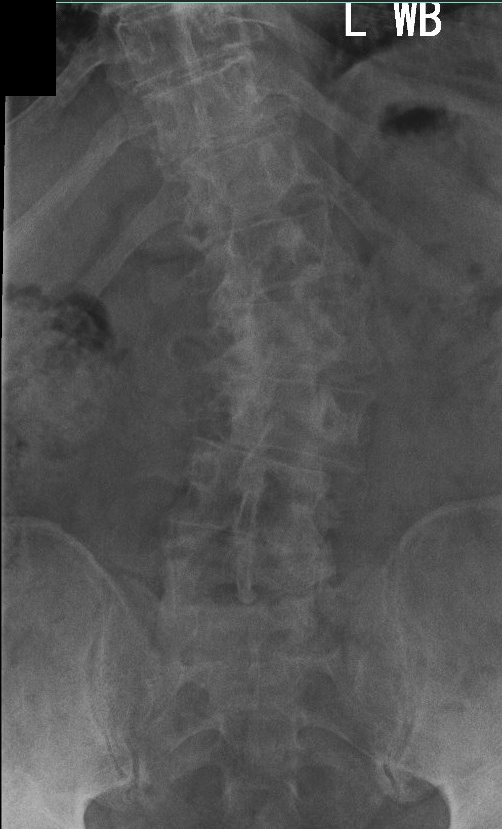
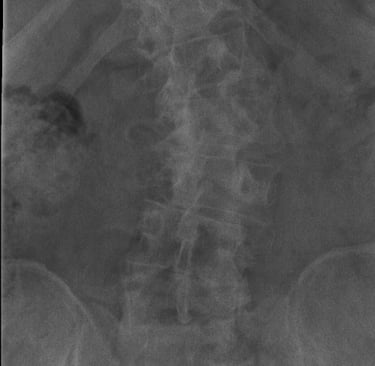
Lumbar spine X-ray, November 2024. University Health, San Antonio. Scoliotic curvature and multilevel degenerative changes. Personal medical record.
What the Imaging Shows
Foraminal Stenosis — L4-L5 and L5-S1
Imaging: MRI, December 9, 2024. CT, December 28, 2024 (follow-up). University Health, San Antonio.
My MRI showed moderate left-sided neural foraminal stenosis at L4-L5, with my exiting L4 nerve root abutted by the disc and bone. At L5-S1, it was worse — moderate to severe left-sided stenosis, with the L5 nerve root abutted directly in the foramen. Nineteen days later, a CT of the same region confirmed it and went further: at L4-L5, osteophytes and facet arthropathy "severely narrow" the left foramen; at L5-S1, a disc/osteophyte complex does the same. Two studies, two modalities, same left side, same levels.
I'd gone in with lumbago and left-sided sciatica. That's the same side both scans confirmed as compressed.
What I did with that afterward is documented on this page, in the lift videos, and in the Spine Chronicle. This page states what the imaging showed — not instruction for what to do with a similar finding. That's a conversation for you and your own physician.
Related records: Lifts
44° Scoliosis
Imaging: X-ray, December 4, 2020. Confirmed unchanged in follow-up films through 2024.
I knew I had scoliosis at 14. I didn't understand the depth of it until my 2020 spine X-ray — a sigmoid curvature, 44 degrees dextrocurvature between T5-T11, 31 degrees levocurvature between T11-L4. Two curves, opposite directions, forming an S. Disc height loss and facet arthropathy ran across both the thoracic and lumbar spine, worst at T10-T11 and L2-L3.
Cramps, spasms, and something I've stayed conscious of for years: taking a deep breath. Scoliosis can restrict chest wall expansion and, in more severe curves, compress or displace lung tissue. Mine hasn't been studied for that specifically. It's just something I've paid attention to.
Four years later, a follow-up X-ray found the curvature unchanged — same shape, same levels, directly compared against the 2020 film — and added something new: osteopenia, present for the first time on record. Four years of continued heavy axial loading in that same window. Not despite it. Through it.
The same caution that flags lung risk in more severe curves, or bone density risk under load, is the caution I've been told applies to me — stop lifting, the curve is too much, the load is too much. My imaging says the curve hasn't moved in four years of exactly that load. I'm not disputing what the research says about scoliosis generally. I'm documenting that my own case sits outside where that caution was built to apply.
Related records: Lifts
Degenerative Disc Disease — Cervical, Thoracic, Lumbar
Multilevel degenerative disc disease is present across all three regions of my spine. The 2020 X-ray documented diffuse disc height loss, endplate hypertrophy, and facet arthropathy, most pronounced at T10-T11 and L2-L3. The August 2022 lumbar X-ray confirmed disc space narrowing at nearly every lumbar level, with vacuum phenomena at L3-L4 and L5-S1. Lumbar-level detail for L4-L5 and L5-S1 is covered above under Foraminal Stenosis.
The cervical spine is confirmed separately: a March 2022 X-ray found grade 1 anterior listhesis of C3 on C4 and C4 on C5, disc height reduction at C6 (25%) and C7 (50%), and severe degenerative changes at C5-C6, C6-C7, and C7-T1. The same read confirmed an age-indeterminate compression deformity at C7. The radiologist couldn't date it. No injury event is on my record. The deformity exists; its origin doesn't appear in the imaging.
No surgical intervention on my spine has ever been performed. None is currently scheduled.
Related records: Lifts
Bilateral Sciatica
Imaging: MRI Dec 9, 2024; CT Dec 28, 2024. Symptom history: MyChart records, University Health.
The sciatica radiates to both feet. It's not episodic — it doesn't come and go with activity or rest. It's present every day, both sides.
My clinical intake notes across four imaging studies list the referral reason as left-sided — that's what each visit was coded for. My MyChart records separately document right-sided symptoms too, at different times. The imaging backs up both sides independently, even though the referrals only asked about the left: on the right, my MRI found mild foraminal stenosis at L1-L2, L3-L4, and L5-S1, with my exiting L3 nerve root abutted at L3-L4 despite only mild stenosis there; my CT nineteen days later found moderate-approaching-severe right-sided narrowing at L2-L3, driven by an osteophyte. On the left, the more advanced findings — worst at L4-L5 and L5-S1, both with confirmed nerve root abutment.
This is my own documented record, my own understanding of what follows from it — not a general claim about how sciatica presents, and not instruction for interpreting anyone else's imaging.
Related records: Lifts
The SSDI Question:
The imaging on file — multilevel cervical degenerative disease with grade 1 anterolisthesis, severe lumbar foraminal stenosis with confirmed nerve root abutment at L4–L5 and L5–S1, bilateral sciatica radiating to both feet, and diffuse thoracic spondylosis — reflects a presentation that, based on my own lay research into SSA criteria, I understand could meet the threshold for Social Security Disability Insurance consideration. I have never filed. That is a choice, not an oversight. No physician has formally assessed or documented my SSDI eligibility. I am noting this because it is part of how I understand my own record — not as a clinical finding.
What My Body Is Doing Under This Load
Important: The output below is a personal record only. It is not a training recommendation. Do not attempt to replicate any of the following without guidance from a licensed physician who has reviewed your imaging and personal history. These numbers describe one body under one set of documented conditions. They do not describe yours.
At 60 years old, my documented training output includes the following.
I shrug 550 pounds. The shrug is the most directly spine-loaded lift in this record. The bar rests on my hands with the full load transferred through my traps, across a spine with a 44-degree primary scoliotic curve, multilevel degenerative disc disease, and confirmed foraminal stenosis at multiple lumbar levels. There is no squat rack to share the load. There is no hip hinge to distribute it. The 550 pounds is axially loaded through the thoracolumbar spine on every rep. I state this plainly because the imaging above needs to be read in full before this number means anything.
My highest leg press was 1,658 pounds, performed many times: sixteen 45-pound plates per side, 25-pound plates on all four posts, and the 118-pound sled. As the sled's end caps wore down, I swapped those for two 25s and two 10s and worked at 1,628 pounds. My current standard load is 1,558 pounds: sixteen 45-pound plates per side (1,440 pounds) plus the 118-pound sled, the most the worn end caps hold safely. These are full system weights, sled included.
On the leg press sled, I perform calf raises — toe raises starting with the sled only (118 lb) and pyramiding up through ten 45-pound plates per side, reaching 1,018 pounds total at the peak. I complete 15 reps per set throughout the pyramid.
My single-arm lat pull is 270 pounds per side. My one-arm dumbbell press is 125 pounds, for five reps.
I am stronger at 60 than I was at 38. I am considerably stronger than I was in my 20s. This is documented in the training record. It is not estimated.
The knee record — right medial meniscectomy 1980, bone-on-bone for 46 years — is documented separately at /knees. The bloodwork context — verified natural, no TRT, no HGH, no PEDs — is at /natural. What this training record implies about strength and aging in general is at /strength-and-age.
What This Site Is — and Is Not
Exception Nation is a documentation site. The medical record is the primary source. The physical output is secondary documentation. The relationship between the two is observable, not instructional.
Nothing on this page is a training recommendation. Nothing here implies that a body with similar findings should produce similar output, or attempt to. I am not presenting this record as a template, a Chronicle, or a recommendation. I am presenting my record as a record.
Documented by Jonas Virgil Monos. Published by Exception Nation LLC. Medical disclaimer.
This is a personal record. It is not medical advice. Decisions about your spine belong between you and a licensed physician you trust.
Free PDF — 5 Movements a Week: What I Actually Do for My Spine
Five movements I return to most weeks with 44-degree scoliosis, multilevel degenerative disc disease, and severe foraminal stenosis on file. Personal record. No program. No prescription.
Send me the PDF →
Stay on the record. Get updates when new documentation is published. Add my name to the email.


Content on ExceptionNation is for informational and educational purposes only and is not a substitute for professional medical advice, diagnosis, or treatment. The experiences documented here reflect choices made — sometimes with physicians, sometimes on their own terms. You are responsible for your own choices, made in consultation with a licensed provider you trust.
ExceptionNation LLC · Texas · support@exceptionnation.com